AI and Music update: June 2026

AI and copyright: what's been happening
Sign the Paris Commitment at cisac.org/pariscommitment
APRA AMCOS continues to lobby directly with Canberra and with our colleagues around the globe for your rights as songwriters, composers and publishers.
There have been significant developments over the past few weeks. The annual Australian Financial Review AI Summit in Sydney in early June saw Tech Council of Australia Chair Scott Farquhar once again call for changes to Australian copyright law to benefit AI companies at the expense of creators.
We responded with coverage landing in the AFR, Mediaweek, The Music and Limelight. Dean also featured in an online ABC Four Corners story, where he said: "The issue isn't the law. It's that the major AI platforms don't want to pay. Not one has made a genuine attempt to come to the table, engage with rights holders, or explore what a fair commercial negotiation might look like. The content that drives the value of these models is the highest quality catalogued creative work — the songs, the scores, the novels, the screenplays, built by professional creators over careers and lifetimes. That is what they keep coming back for. And that is precisely what Australia's copyright framework is designed to protect."
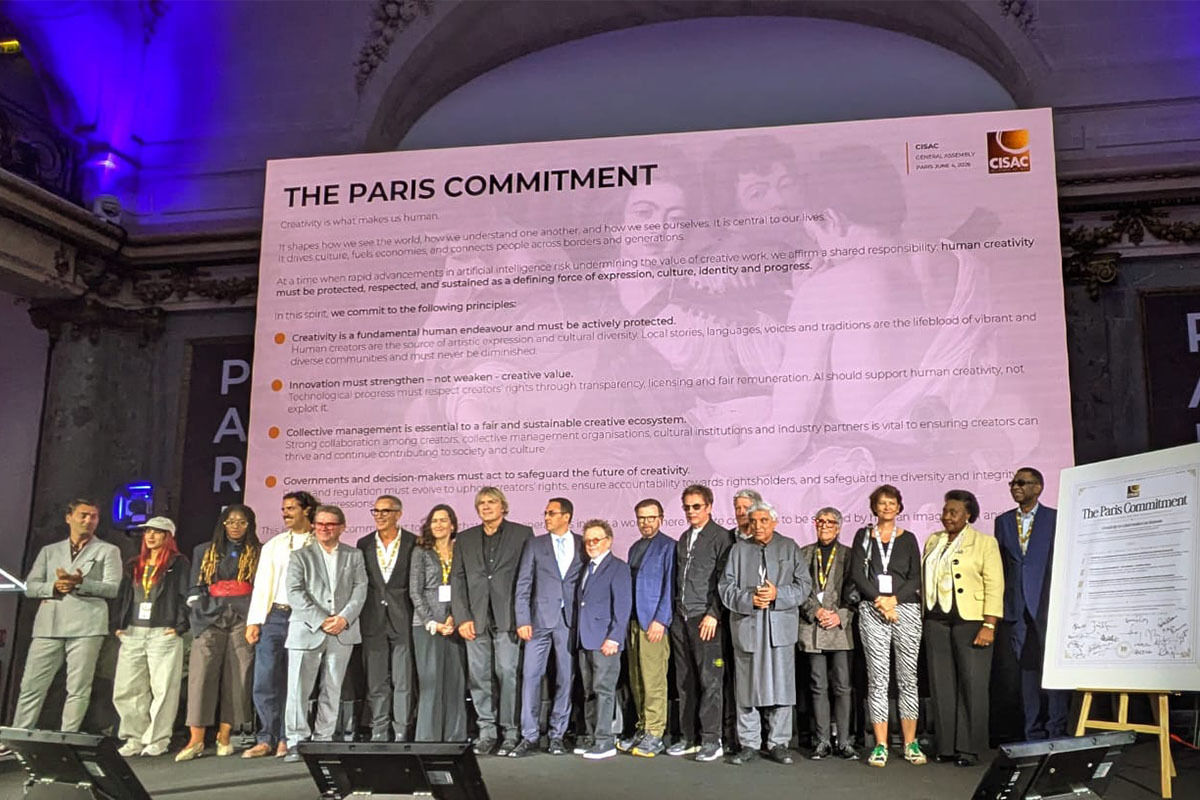
APRA AMCOS is also working closely with our colleagues and sister societies around the world. We worked with CISAC on the development of the Paris Commitment, adopted at the General Assembly in Paris last week. The commitment is a landmark global declaration and one you can sign too.
Sign your name to the commitment at cisac.org/pariscommitment.
ABBA co-founder and CISAC President Björn Ulvaeus said: "Creativity is one of the deepest expressions of our humanity. The Paris Commitment sends a united message from creators around the world: human creativity must continue to be valued, respected and protected." You can watch his full keynote on creativity, AI and what it means to make something below.
WATCH: Björn Ulvaeus on AI, Human Creativity & the Future of Music | CISAC General Assembly 2026
Dean also spoke at the Assembly: "Every time a new industry has been built on creative work, the law recognised that creators are entitled to be paid. The technology changed. But the principle did not. Whether broadcast over the airwaves, downloaded from the internet, streamed through a phone, or copied into an AI system, the premise is the same. Creators must be paid for the use of their work."
Global AI Wrap-up
Here is a round up of where the global policy debate is moving.
Australia
Australia was the first major jurisdiction in the world to reject a broad text and data mining exception, the legal mechanism AI companies have been pushing for that would allow them to train on your creative work without consent or payment. That position hasn't moved. The government's view, reinforced repeatedly by Attorney-General Michelle Rowland, is that broad TDM exceptions would transfer economic value from creators to AI developers without consent or remuneration.
In March, APRA AMCOS joined the broader rightsholder coalition spanning music, news, screen and publishing for a parliamentary event, Powering Intelligence, which brought together parliamentarians, senior public servants and industry leaders. The Attorney-General opened. Senator Sarah Henderson also spoke, reflecting the bipartisan support the creator position has built. The Tech Council and Business Council continue to lobby for exceptions, but the government's position has not shifted.
UK
Over the last year, the UK Government began consulting on a TDM exception for AI companies. After receiving 11,500 consultation submissions, 88% backing licensing, the government formally abandoned that position in March, acknowledging it had been "wrong" to express that preference. The existing narrow non-commercial research exception remains in force. Everything else is back under review, with the government saying it won't commit to reform until it is confident changes will meet its objectives as they monitor the licensing market develop.
No AI legislation appeared in the May King's Speech. The House of Lords recommended the broad TDM option be ruled out entirely and calling for statutory transparency obligations at a level of detail that rights holders actually need. Digital replicas and "in the style of" protections have been flagged as the near-term legislative priority.
France
The Darcos Bill, named after Senator Laure Darcos, who introduced it the bill was unanimously passed by the French Senate in April. The bill is a world first and would flip the burden of proof in AI copyright disputes: where credible evidence exists that an AI company used your work in training, the obligation falls on them to demonstrate it wasn't used. The French Council of State confirmed it was fully constitutional and compatible with EU law.
At the CISAC General Assembly in Paris on 4 June, all 227 member societies, including APRA AMCOS, signed a joint statement calling on the French National Assembly to pass the bill without delay. The statement described the large-scale use of creative works to train AI systems without authorisation or compensation as "the greatest plundering of creative and artistic works ever perpetrated." It also made clear the bill creates no new rights and its purpose is to make existing rights effectively enforceable.
The bill has since been kept off the National Assembly's June agenda. The next window is September. In the meantime, 81 French cultural and media organisations continue to lobby for it to be scheduled. The practical stakes are significant: without the presumption, creators still carry the full burden of proving use from datasets they cannot access.
EU
Under the EU AI Act, copyright compliance obligations for AI companies including publishing a detailed summary of training data and respecting rights reservations came into force in August 2025. From 2 August 2026 the AI Office gains full enforcement powers, including fines of up to €15 million or 3% of global turnover. This week the Commission also published draft guidelines on how labelling obligations for AI-generated content will work in practice.
On 10 March, the European Parliament adopted a resolution calling on the Commission to go further: a mandatory training data register administered by the EUIPO, machine-readable opt-out rights for creators, full itemised transparency over every copyright-protected work used in training, and a compulsory remuneration regime. The resolution is non-binding but carries significant political weight.
United States
There are now more than a hundred active copyright cases related to AI training in US courts. The volume is pushing some AI companies toward licensing negotiations rather than prolonged litigation. One recent case makes the market harm concrete: ambient duo The American Dollar sued Suno in May, documenting an 80% collapse in licensing revenue from the date of Suno's public launch and showing that prompts referencing their track titles generated outputs mimicking their music.

There are now more than a hundred active copyright cases related to AI training in US courts.
India
India has proposed a framework called 'One Nation, One Licence, One Payment' a statutory licensing model where AI companies obtain a blanket authorisation and pay into a central pool, applied retroactively to past uses. It removes individual consent entirely. CISAC and creator groups have opposed it sharply for precisely that reason. The consultation closed in February.
Brazil
Brazil's Senate passed a bill last year with a strong copyright chapter: mandatory disclosure of training data, creator opt-out rights, collective licensing through societies, and remuneration scaled to the AI company's size and frequency of use. Major Brazilian artists including Marisa Monte and Roberto Frejat campaigned publicly for the protections. The bill is now in the lower house, where tech industry lobbying is intense and the copyright provisions are under sustained pressure.