
The annual Art Music Awards are presented by APRA AMCOS in conjunction with the Australian Music Centre (AMC) to recognise achievement in the composition, performance, education, and presentation of Australian music.
Art Music covers activity across contemporary classical music, contemporary jazz, improvised music, experimental music, and sound art.
The 2026 Art Music Awards were held at The Timber Yard, Melbourne on Wednesday 19 August.
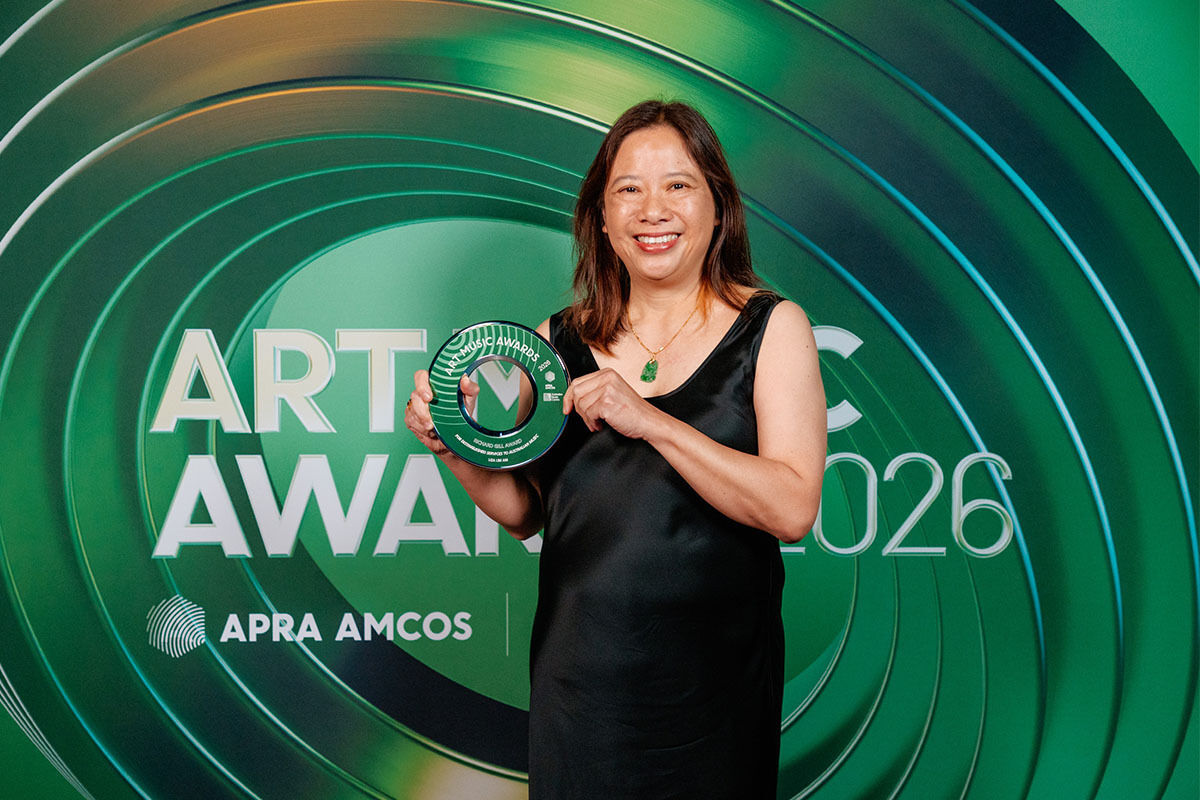


Recipients & Finalists
| Richard Gill Award for Distinguished Services to Australian Music |
|---|
Recipient |
LIZA LIM AM |
| State / Territory Luminary Award |
|---|
Australian Capital Territory |
MICHAEL SOLLIS fOR work as an artistic leader, community facilitator, composer and educator |
New South Wales |
PEOPLE'S REPUBLIC for significant contributions as a venue, promoter and studio for new and experimental music |
Queensland |
ALEX RAINERI for his work as an extraordinary musician, director and creator, and for fostering performance, collaboration and new creative opportunities through the Brisbane Music Festival |
South Australia |
MELANIE WALTERS for work as Principal Flute of Adelaide Wind Orchestra, Artistic Director of Coruscalia Collective and champion of new music in South Australia |
Tasmania |
VAN DIEMEN'S BAND for presenting world-class music to regional and remote communities, commissioning new Australian works alongside 400-year-old masterpieces, and building a deep, reciprocal trust with audiences |
Victoria |
CHAMBER MADE for shaping Australian music and performance for more than 35 years through ambitious, internationally engaged productions, and investment in composers, sound artists, and performance makers |
Western Australia |
HANNAH LEE TUNGATE for Tenth Muse Initiative and Women Composers Project |
| Luminary Award: National Individual |
|---|
Recipient |
| Daryl Buckley |
Finalists |
| Assoc Prof Dr Jeanell Carrigan AM |
| Jeremy Rose |
| Jon Smeathers |
| Luminary Award: National Organisation |
|---|
Recipient |
| Musica Viva Australia |
Finalists |
| Flinders Quartet |
| Forest Collective |
| Rubiks Collective |
| Work of the Year: Choral | |
|---|---|
Recipient | |
| Title: | Mahāsāgar |
| Composer: | Paul Stanhope* |
| Text: | Rhys Halkidis, Steve Hawke, Michael Leunig, Cass Lynch, Alexander Maloof and Elizabeth Riddell |
| Publisher: | Wise Music* |
| Performer: | West Australian Symphony Orchestra and Chorus with Sara Macliver (soprano), Andrew Goodwin (tenor), and Asher Fisch (conductor) |
Finalists | |
| Title: | Adira Arenio and Agnus Dei |
| Composer: | Alice Chance with Kaylynn Zaro OAM and Noel Zaro OAM |
| Performer: | Sydney Philharmonia Choirs VOX and Elizabeth Scott (conductor) |
| Title: | There is Music |
| Composer: | Stephen Leek |
| Text: | Jane Greenwood |
| Performer: | Brisbane Chamber Choir |
| Title: | Vivemus Cantare |
| Composer: | Carl Crossin |
| Text: | James Weldon Johnson, Walt Whitman and Carl Crossin |
| Performer: | Adelaide Chamber Singers and Christie Anderson (conductor) |
| Work of the Year: Dramatic | |
|---|---|
Recipient | |
| Title: | Opera for the Dead |
| Composer: | Mindy Meng Wang and Monica Lim |
| Performer: | Mindy Meng Wang, Monica Lim, Yu-Tien Lin, Nils Hobiger and Alexander Meagher |
Finalists | |
| Title: | Hiroshima mon Amour |
| Composer: | Rósa Lind |
| Text: | Marguerite Duras |
| Performer: | Bozzini Quartet and Chants Libre |
| Title: | Living Poems of the Sea |
| Composer: | Lyle Chan |
| Performer: | Sally Walker (flutes, narration, percussion) |
| Title: | Pigeon Humongous |
| Composer: | Nicholas Roder |
| Performer: | Nicholas Roder, Merinda Dias-Jayasinha, Lena Douglas, Lewis Coleman, Sydney Dance Company, and Harrison Ritchie-Jones (choreographer) |
| Work of the Year: Electroacoustic/Sound Art | |
|---|---|
Recipient | |
| Title: | Dark Oceanography |
| Composer: | Kate Milligan |
| Music Technologist: | Aaron Wyatt |
| Oceanographer: | Navid Constantinou |
| Performer: | Louise Devenish (Director), Niki Johnson, and Sofia Carbonara (The Sound Collectors Lab) |
Finalists | |
| Title: | Exhalation |
| Composer: | Madeleine Flynn and Tim Humphrey |
| Visual Artists: | Vuth Lyno, Pal Panha, Leang Titnita and Phan Sophorn |
| Performance Contributors: | Madeleine Flynn, Tim Humphrey, Helen Svoboda, Winter McQuinn, Robert Larsen (speaker design), Tom McKeand (sound design) and Pat Telfer (sound engineer) |
| Title: | For A Moment the Sky Knew My Name |
| Composer: | Peter Knight |
| Performer: | Peter Knight |
| Title: | Swell |
| Composer: | Annie Hui-Hsin Hsieh |
| Performer: | Phoebe Green |
| Work of the Year: Jazz & Improvised Music | |
|---|---|
Recipient | |
| Title: | When All Is Still and Quiet |
| Composer: | Nat Bartsch |
| Publisher: | Origin Music Publishing |
| Performer: | VCA Secondary School Improvisation Ensemble & Chamber Choir |
Finalists | |
| Title: | Northern Rhapsody |
| Composer: | Hamed Sadeghi |
| Performer: | Eishan Ensemble (Hamed Sadeghi, Michael Avgenicos, Max Alduca and Adem Yilmaz) |
| Title: | The Cloud Maker |
| Composer: | Aviva Endean, Te Kahureremoa Taumata, Sunny Kim, Maria Moles and Freya Schack-Arnott |
| Performer: | The Cloud Maker |
| Title: | To Kill A Magic We Got Used To |
| Composer: | Aaron Choulai and Roman MC |
| Performer: | Australian Art Orchestra |
| Work of the Year: Large Ensemble | |
|---|---|
Recipient | |
| Title: | the ocean's dream of itself |
| Composer: | Alex Turley |
| Performer: | Sasha Cooke, Donald Runnicles and Grand Teton Music Festival Orchestra |
Finalists | |
| Title: | Nguy Gapu (Ocean Water) |
| Composer: | Rrawun Maymuru and Nick Wales* |
| Publisher: | Wise Music* |
| Performer: | Rrawun Maymuru and the Australian Brandenburg Orchestra |
| Title: | Symphony No. 4, Op. 119 |
| Composer: | Andrew Schultz |
| Performer: | West Australian Symphony Orchestra and Otto Tausk (conductor) |
| Title: | Clarinet Concertino: Second Chance |
| Composer: | Ben Robinson |
| Performer: | Tasmanian Symphony Orchestra, Eloise Fisher (solo clarinet) and Simon Reade (conductor) |
| Title: | The way it soars, the way it dances |
| Composer: | Naomi Dodd |
| Performer: | Jennifer Owen and Tasmanian Symphony Orchestra |
| Work of the Year: Medium Ensemble | |
|---|---|
Recipient | |
| Title: | BloodRiverRootTree |
| Composer: | Noemi Liba Friedman |
| Performer: | Meg Cohen, Phoebe Green, Alex McDonald, Roseanne Hunt, Peter Neville, Hamish Gould, Sarvenaz Monfaredi, Justine Anderson, Shelby MacCrae, Sophie Deka.and Jakob Bragg (conductor) |
Finalists | |
| Title: | Four Rooms |
| Composer: | Lee Bradshaw |
| Performer: | Flinders String Quartet and Australian Youth Orchestra Chamber Players |
| Title: | The Big Idea |
| Composer: | Matthew Shlomowitz |
| Performer: | Rubiks Collective and Lotte Betts-Dean |
| Title: | Sonnet of an Emigrant |
| Composer: | Cathy Milliken |
| Performer: | Takacs Quartet |
| Work of the Year: Solo & Small Ensemble | |
|---|---|
Recipient | |
| Title: | Killing the Angel in the House |
| Composer: | Anne Cawrse |
| Performer: | Eliza Shephard |
Finalists | |
| Title: | Duet for one |
| Composer/Multimedia: | Damian Barbeler |
| Multimedia: | Tim Gruchy |
| Performer: | Sonya Lifschitz |
| Title: | Tidelines |
| Composer: | Zela Papageorgiou, Alistair McLean and Hamish Upton |
| Performer: | Zela Papageorgiou and Hamish Upton |
| Title: | Yama no Yume |
| Composer: | Jim Franklin |
| Performer: | Jim Franklin |
| Performance of the Year: Classical & Experimental | |
|---|---|
Recipient | |
| Performer: | Australian String Quartet & Dr Lou Bennett AM |
| Title: | nyilamum song cycles |
| Composer: | Dr Lou Bennett AM and Paul Stanhope* |
| Publisher: | Wise Music* |
Finalists | |
| Performer: | Duckworth Hullick Duo |
| Title: | Disruptive Critters |
| Composer: | James Hullick and Jonathan Duckworth |
| Performer: | Sonja Schebeck with Joshua Frazer and Allie Wang |
| Title: | LIMBO Sonata |
| Composer: | Chloé Charody |
| Performer: | Speak Percussion |
| Title: | Pigeons |
| Composer: | Eugene Ughetti |
| Text: | Kaylie Melville, Nick Roux, Jason Lehane, Bosco Shaw, Keith Tucker, Kate Davis and Bruce Gladwin |
| Performance of the Year: Jazz & Improvised Music | |
|---|---|
Recipient | |
| Performer: | The Cloud Maker |
| Title: | The Cloud Maker |
| Composer: | Aviva Endean, Sunny Kim, Maria Moles, Te Kahreremoa Taumata and Freya Schack-Arnott |
Finalists | |
| Performer: | Aviva Endean, Cahwatie Sugiarto and Matthias Schack-Arnott |
| Title: | Lung Swara |
| Composer: | Aviva Endean, Cahwatie Sugiarto and Matthias Schack-Arnott |
| Performer: | Mad Vantage |
| Title: | PRESS |
| Composer: | Selene Messinis and Timothy Cox |
| Performer: | Delay 45 and Ensemble Apex |
| Title: | Ghosts Between Streams II |
| Composer: | Tom Avgenicos |
| Performance of the Year: Soloist | |
|---|---|
Recipient | |
| Performer: | Nick Russoniello |
| Title: | Air Mass Suite |
| Composer: | Nick Russoniello |
Finalists | |
| Performer: | Claire Edwardes (soloist) with Tasmanian Symphony Orchestra and Benjamin Northey (conductor) |
| Title: | Dances with Devils |
| Composer: | Iain Grandage |
| Performer: | Mindy Meng Wang (soloist) and MSO |
| Title: | Concerto for Guzheng and Orchestra |
| Composer: | Jessica Wells |
| Performer: | Sonya Lifschitz |
| Title: | Duet for One |
| Composer/Multimedia: | Damian Barbeler |
| Multimedia: | Tim Gruchy |
| Award for Excellence in Experimental Practice |
|---|
Recipient |
| Chamber Made for 2025 presentations and artist development activities |
Finalists |
| Mindy Meng Wang for excellence in experimental music and ongoing contribution to the Australian art music scene |
| The Sonicrats for The Music Makers' program |
| Shaun Fogarty for SOUNDSTONE |
| Award for Excellence in Music Education |
|---|
Recipient |
| Wollongong Conservatorium of Music for Music in Schools program |
Finalists |
| Ensemble Offspring for Hatched Academy |
| Speak Percussion for Sounds Unheard Program & 25th Anniversary Exhibition |
| Tim Nikolsky for Australian Jazz Real Book |
| Award for Excellence in a Regional Area |
|---|
Recipient |
| Chamber Music Adelaide and Port Augusta Performing Arts for Where We Meet: Chamber Music |
Finalists |
| Moorambilla Voices for sustained leadership in delivering artistically excellent, culturally grounded music-making in regional and remote NSW |
| Tura and Marninwarntikura Women's Resource Centre for Buga Yanu Junba (Songs for Young Children) |
| Van Diemen's Band for VDB Lunchbox Concerts |
Nomination Process
NOMINATIONS FOR THE 2026 ART MUSIC AWARDS HAVE CLOSED.
HOW TO NOMINATE:
Nominating is now simpler than ever!
Step 1: To nominate you need to be either:
- A member of APRA AMCOS (Composer, Author or Publisher member)
- A financial member of the Australian Music Centre (AMC). You can join here.
Step 2: Read through the 'Categories' and 'Rules & Guidelines' below to ensure your nomination meets the criteria.
Step 3: Head to the Art Music Awards portal.
Step 4: Provide essential information about your nominee/s (category, work, name of nominee etc.).
Step 5: Write a short paragraph on why you're nominating this person/organisation/work and THAT'S IT!
Please note that you cannot self-nominate in any category unless otherwise stated. Self-nominations will not be accepted.
IF YOU GET NOMINATED:
If you are nominated, we'll be in touch with you via email after the nomination period closes.
Step 1: Confirm that you'd like to accept the nomination, or select which nomination to proceed with if you have been nominated with multiple options in a single category.
Step 2: Submit all requested support material by the due date.
Step 3: Provide any press material (additional photos, videos or bio information) to be used if you are selected as a finalist.
NOMINATIONS FOR THE 2026 ART MUSIC AWARDS HAVE CLOSED.
Categories
The Art Music Awards consists of sixteen awards (for works, performances, and excellence in education, regional areas, and experimental practice), and up to ten Luminary awards (for sustained contribution of individuals or organisations to their state/territory community or on a national scale). Additionally, the Richard Gill Award for Distinguished Services to Australian Music is presented at the discretion of the Board of Publisher and Writer Directors of APRA.
Work of the Year: Choral
Accompanied or unaccompanied works for multiple voices, where the vocal parts are the focus of the work.
Work of the Year: Dramatic
Music primarily intended for theatre and dance, such as opera, music theatre and ballet and contemporary dance works.
Work of the Year: Electroacoustic / Sound Art
Works which utilise and manipulate digital and/or analogue sound as the primary medium. The work may be interdisciplinary (incorporating more than one medium). Including but not limited to: electronics, interactive work, generative music, environmental sound, installations, soundscapes, electroacoustic music and intermedia works.
Work of the Year: Jazz & Improvised Music
Original works of any instrumentation, primarily engaging with improvisatory composition and/or jazz traditions.
Work of the Year: Large Ensemble
Works for more than 13 players, with or without vocal parts, and with or without electronics. This may include works for orchestra, concert band, wind band, string orchestra.
Work of the Year: Medium Ensemble
Works for between 5 and 12 players, with or without vocal parts, and with or without electronics.
Work of the Year: Solo & Small Ensemble
Works for between 1 and 4 players, with or without vocal parts, and with or without electronics.
Performance of the Year: Classical & Experimental
For ensemble performances of an Australian contemporary classical or experimental work, often showcasing the performers’ success in revealing the nature and intention of a composition with clear notated instructions for the performer.
Performance of the Year: Jazz & Improvised Music
For ensemble performances of an Australian contemporary jazz or improvised work, often showcasing the performers’ success in improvisatory creation or collaboration. This may entail entirely improvised work or significant improvisatory input such as solo passages.
Performance of the Year: Soloist
For the performance of a solo works or for a featured soloist in a larger work (such as a jazz solo, or concerto. Open to all genres of art music including classical, jazz, experimental and improvised music.
Award for Excellence in Music Education
For pedagogical, creative, or professional development activities that champion Australian art music repertoire, including specific projects, recordings or recording projects, or events undertaken by an individual or organisation.
Award for Excellence in a Regional Area
For activities undertaken in a regional area, by local community, or in collaboration with the local community, that utilise Australian repertoire to create a positive impact in the area. Metropolitan artists working regionally must be nominated with a regional partner as co-nominee, ensuring shared recognition.
Note: To better support regional artists, self-nominations will be trialled for the Excellence in a Regional Area category in 2025.
Award for Excellence in Experimental Practice
For works, people or events that interrogate, extend, or challenge standard artistic practice within their segment of the Australian art music sector.
Luminary Awards
The Luminary Awards seek to honour individuals and organisations who through sustained contribution (demonstrated over a period 3-5 years prior). These nominees will have impacted the national or local community (as appropriate) through visionary leadership, fearless trailblazing, high-level artistic practice, and championing of Australian repertoire.
Awarded in the following categories:
National (Individual)
National (Organisation)
State/Territory - ACT, NSW, NT, QLD, SA, TAS, VIC, WA
Richard Gill Award for Distinguished Services to Australian Music
Presented at the discretion of the APRA and AMC Boards of Directors, the Richard Gill Award for Distinguished Services to Australian Music seeks to honour an individual, group or organisation who through sustained contribution over a number of years, have impacted our community on a national scale through visionary leadership, fearless trailblazing, high-level artistic practice, and championing of Australian repertoire.
Rules & Guidelines
1. General Information
The Art Music Awards are presented annually by APRA AMCOS and the Australian Music Centre (AMC) to celebrate the achievements of Australia’s art music community. Awards are presented across the following categories:
- Work of the Year – 7 categories
- Performance of the Year – 3 categories
- Excellence Awards – 3 categories
- Luminary Awards – up to 10 awards for sustained contribution
- The Richard Gill Award – for Distinguished Services to Australian Music
2. Nomination & Eligibility
- All nominations and supporting materials must be submitted via the online nomination form at artmusicawards.apra.com.au
- Who can nominate?
- APRA AMCOS composer or publisher members
- Current financial members of the Australian Music Centre
- Nominee process:
- Nominees will be notified of all nominations received. They will then select which nomination to proceed with and provide the required materials.
- Each nominee may submit one nomination per award category.
- Use of Indigenous content:
- If a work includes Indigenous content (e.g., language, titles, narratives, or themes) from outside the nominee’s own cultural heritage, documentation must be provided showing consultation with the appropriate communities and permission to use their cultural content and intellectual property.
- Nominations without the required documentation will be deemed ineligible.
- APRA AMCOS and AMC reserve the right to:
- Not present an award in any category, or
- Defer a category to the following year if six or fewer eligible nominations are received.
- Self-nominations are not permitted, unless otherwise noted. This includes nominating:
- Yourself
- People or organisations you work for, represent, or employ
- All categories are open to all genres and practices of art music, including but not limited to:
- Contemporary classical
- Contemporary jazz
- Notated composition
- Improvised music
- Digital music
- Sound art
- Experimental practice
3. Nominee Licence
By submitting material to the Art Music Awards, the nominee (or the copyright owner, if different) agrees to:
- Performance and Recording Rights
- Permit APRA AMCOS, and any authorised party, to perform the entry during the Art Music Awards ceremony if appropriate.
- Allow the entry to be recorded for the ceremony, public communication, and promotional purposes.
- Promotional Use
- Allow APRA AMCOS to use audio and video related to the nomination package for promotional purposes.
4. Work of the Year Categories
The seven Work of the Year categories are:
- Small Ensemble – Works with 1–4 parts, with or without vocal parts or electronics.
- Medium Ensemble – Works with 5–12 parts, with or without vocal parts or electronics.
- Large Ensemble – Works with 13+ parts, with or without vocal parts or electronics.
- Choral – Accompanied or unaccompanied works for multiple voices.
- Dramatic – Music primarily intended for theatre or dance (e.g., opera, music theatre, contemporary dance, ballet).
- Electroacoustic / Sound Art – Works using digital and/or analogue sound as the primary medium, including interdisciplinary works.
- Jazz & Improvised Music – Works primarily engaging with jazz and improvisation.
Definition of a Work:
A work is a single complete musical composition or expression. This includes:
- Music with movements or sub-works (e.g., song cycles)
- Installations
- Real-time compositions (improvised music)
Eligibility Requirements:
- Composed by an Australian citizen or permanent resident registered with APRA AMCOS and/or AMC.
- First made publicly available (live or digital performance, broadcast, or commercial release) within the year prior to the Award (2025).
- A work may only be submitted in one category. If eligible for multiple categories, the nominee must choose one.
- Self-nomination by composers is not permitted in Work of the Year categories.
- All categories are open to all genres and practices of art music, including but not limited to:
- Contemporary classical
- Contemporary jazz
- Notated composition
- Improvised music
- Digital music
- Sound art
- Experimental practice
5. Performance of the Year Categories
The three Performance of the Year categories are:
- Classical & Experimental – Performances of Australian classical and experimental works.
- Jazz & Improvised – Performances of Australian jazz and improvised works.
- Soloist – Performances of Australian solo works, or soloists featured within larger works (open to all art music genres).
Eligibility Requirements:
- The performance must have taken place publicly during the calendar year prior to the Award (2025).
- Performances may occur anywhere in the world.
- The work performed must be composed by an Australian citizen or a composer with permanent residence in Australia.
- There is no restriction on the year of composition (heritage works are eligible).
- Public broadcast of a live studio or concert performance in the same year qualifies as a public performance. This includes:
- Radio broadcasts
- Live streams
- Podcasts
- Other digital distribution of a live recording
- Performances of non-score-based works are encouraged.
- A performance may only be submitted in one category. If eligible for multiple categories, the nominee must choose one.
- Self-nomination by performers is not permitted in Performance of the Year categories.
6. Excellence Categories
The Excellence Awards recognise outstanding contributions to Australian art music across three categories:
- Award for Excellence in Experimental Practice
For works, people, or events that interrogate, extend, or challenge standard artistic practice within the Australian repertoire. - Award for Excellence in Music Education
For pedagogical, creative, or professional development activities that champion Australian art music repertoire. - Award for Excellence in a Regional Area
For activities undertaken in a regional area, by or in collaboration with the local community, that utilise Australian repertoire to create a positive impact.
Eligibility and Guidelines:
- Awards for Excellence may recognise a range of activities that champion Australian repertoire, including:
- Specific projects
- Activities
- Recordings or recording projects
- Events undertaken by an individual or organisation
- Activities must have taken place in the year prior to the Award (2025).
- Nominations for sustained contribution should be made in the Luminary Award categories instead.
- Previous year winners in any Excellence category are not eligible for nomination the following year.
- Nominations for organisations should demonstrate excellence beyond the standard remit or mission of that organisation.
- Experimental Practice nominations must include a rationale explaining how the work interrogates or extends standard practice.
- Music Education nominations must focus on pedagogical, creative, or professional development activities that champion Australian art music repertoire.
- For the Regional Area Award, metropolitan organisations and individual nominees must provide a regionally based partner as a co-nominee.
- Self-nomination is permitted only in the Regional Area category, in recognition of additional barriers faced by regional artists.
- Self-nomination is not permitted in the Experimental Practice or Music Education categories.
- All Excellence categories are open to all genres and practices of art music, including but not limited to:
- Contemporary classical
- Contemporary jazz
- Notated composition
- Improvised music
- Digital music
- Sound art
- Experimental practice
7. Luminary Awards
The Luminary Awards honour individuals or organisations who have made a sustained contribution to the art music community over a period of 3–5 years.
Categories:
- National Individual
- National Organisation
- State & Territory Awards – ACT, NSW, NT, QLD, SA, TAS, VIC, WA
Eligibility and Guidelines:
- Nominations recognise activities undertaken during the five years prior to the Award (2021–2025).
- Winners are not eligible for nomination in the same category for three years following their award.
- A nominee may be nominated for both a National Luminary Award and one State Luminary Award.
- If multiple State nominations are received, the nominee must select one state based on their geographic location during the period in question.
- Only recipients of State and Territory Luminary Awards will be announced; there are no finalists for these categories.
- Self-nomination is not permitted in Luminary Award categories.
8. Richard Gill Award for Distinguished Services to Australian Music
- This award is presented at the discretion of the APRA and AMC Boards of Directors. Public nominations are not solicited.
- The award honours an individual, group, or organisation that has made a sustained contribution over many years, impacting the national art music community through:
- Visionary leadership
- Fearless trailblazing
- High-level artistic practice
- Championing Australian repertoire
9. Judging Process
For all categories except Luminary Awards:
- Each category is assessed by a panel of three industry judges with relevant expertise, overseen by an independent chair.
- All eligible submissions are provided to the panel for assessment.
- APRA AMCOS and AMC are committed to ensuring diversity of viewpoints across gender, genre, geography, generation, and culture.
- A list of all judges (in aggregate) is published after assessment is completed.
- The panel will select four finalists for each category, including one winner.
For Luminary Awards:
- All Luminary categories are assessed by a single national committee with representatives from:
- QLD
- NSW/ACT
- VIC/TAS
- NT/SA
- WA
- The committee is overseen by an independent chair.
- All eligible submissions are provided to the committee for assessment.
- Diversity principles apply as above.
- The committee will select:
- Four finalists for the National Luminary categories, including one winner.
- One winner for each State/Territory Luminary Award where submissions are received and deemed of worthy quality.
10. Announcement of Finalists & Awards
- Winners of all categories will be announced at the 2026 Art Music Awards ceremony.
- Where applicable, finalists in each category will be announced ahead of the ceremony.
- Recipients of the State & Territory Luminary Awards and the Richard Gill Award for Distinguished Services to Australian Music may be announced ahead of the ceremony, at the discretion of the APRA and AMC Boards of Directors.
- After the ceremony, APRA AMCOS and AMC will publish:
- A list of all judges (in aggregate)
- The chairs’ reports for each category
Venue Accessibility
The Art Music Awards strive to provide fair and inclusive access to their events, and APRA AMCOS is excited to host the 2026 Art Music Awards at The Timber Yard.
Venue address
The Timber Yard
351 Plummer Street, Port Melbourne VIC 3207
The venue is located approximately 10 minutes from Melbourne CBD and is easily accessible by public transport, taxi/rideshare or car.
TRANSPORT
Public Transport
The Timber Yard is five minutes on foot from Bus Routes 234, 235, 236 & 606.
Tram and train connections are available via the CBD, with a short bus ride or walk to the venue.
To plan your journey, please visit the Public Transport Victoria website: https://www.ptv.vic.gov.au/journey
Drop Off Points
Taxi and rideshare services can drop off directly at the front entrance on Plummer Street.
Driving & Parking
The Timber Yard is easily reached by car from the CBD via City Road, Lorimer Street and the West Gate Freeway.
There are 200+ unmetered and untimed spaces on Plummer and Smith Streets and surrounding streets. These spaces cannot be booked, so guests are encouraged to allow for extra time.
AMENITIES & SERVICES
Mobility
The venue is largely flat and is accessible from entry in the Yard to the event space. Some surfaces in other parts of the venue are industrial and can be uneven, so guests are asked to exercise caution when exploring.
Guests with mobility concerns are encouraged to arrive by taxi, Uber or private vehicle and use the Plummer Street entrance for the closest access.
Stairs
There are no stairs located in the Yard or event space.
Accessible Toilets
Accessible toilets are available in the right of the Yard space – please ask a member of staff to locate this for you if needed.
Assistance Animals
Accredited Assistance animals are welcome at the Timber Yard. The venue kindly ask that handlers ensure that any waste or mess created by the animals is cleaned up promptly to help us maintain the venue for all guests.
If you are bringing a assistance animal to the event, please note this when you RSVP.
Assisted Hearing
The 2026 Art Music Awards will be Auslan interpreted. If you require Auslan interpretation for the ceremony please note this on your RSVP in the accessibility requirements to ensure you are seated in the best sight line of the interpreter.
Patrons using hearing aids can access the hearing loop in the auditorium. To utilise the loop, please switch your device to the T position.
Please contact The Timber Yard Box Office with any queries.
National Relay Service
If you are deaf and/or find it hard to hear or speak with people over the phone, you can contact the Timber Yard via the National Relay Service.
As of 20 April 2021, registration is required to use this service. For more information, visit the National Relay Service's website.
Sensory Friendly Space
A sensory friendly space will be available. This area will offer attendees some quiet and calm on event day no matter the size or volume of the crowd and is available for those who have sensory sensitivities, processing differences, or other hidden disabilities (e.g. autism, acquired brain injury, mental illness, PTSD, dementia).
The sensory friendly space is not a social space and is an alcohol-free zone.
Should you require use of the sensory friendly space, please see venue staff or APRA AMCOS staff for directions.
Vision Impairment
There is low lighting in the venue throughout the ceremony. All walkways are clearly marked, however if you have low vision and need assistance, please let a member of staff from APRA AMCOS or The Timber Yard know, our staff will be happy to help.
Wheelchair Positions
If you are attending in a wheelchair please note this on your accessibility requirements on your RSVP and we will allocate you a seat for the ceremony.
SOCIAL STORY
The 2026 Art Music Awards social story can be accessed via this link.
CONTACT US
Should you have any questions or considerations not mentioned in the above, please contact us at [email protected]u or call us on 1800 642 634.
FAQs
What is Indigenous Cultural Content?
Indigenous Cultural Content encompasses information conveyed through tangible and intangible cultural expressions, serving to communicate cultural preservation, artistic expression, political self-determination, and cultural sovereignty. This content, specific to people, place, and culture, extends beyond text, encompassing Indigenous stories, dances, songs, ceremonies, language, history, and other aspects of heritage and property.
APRA AMCOS advocates for the rights of Aboriginal and Torres Strait Islander people to make self-determined decisions regarding Indigenous Music, including defining what Indigenous Music is, determining its usage, specifying when and by whom it is used, and clarifying the purpose of its use.
What is Indigenous Cultural and Intellectual Property (ICIP)?
Indigenous Cultural and Intellectual Property (ICIP) pertains to the rights Indigenous people possess and uphold to safeguard their cultural heritage. ICIP encompasses a dynamic heritage, encompassing objects, sites, stories, images, knowledge, and other content transmitted across generations within a specific Indigenous group or its territory. It is also commonly referred to as "Cultural Heritage."
APRA AMCOS advocates for the global rights of Aboriginal and Torres Strait Islander individuals and communities to autonomously make decisions about their Indigenous Cultural Content and Intellectual Property (ICIP), including (but not limited to):
- Defining the elements contained within Cultural Works
- Determining permissible uses of Cultural Works
- Establishing when Cultural Works are to be utilised
- Setting permissions for those using or exposed to Cultural Works
- Clarifying the purpose behind the usage of Cultural Works
How should I demonstrate support, permissions and, evidence of consultation from the correct owners of Indigenous Cultural Content used or referenced within my works?
When Indigenous Cultural Content from outside of one’s own cultural heritage and background, it is required that appropriate support and permissions are confirmed, obtained, and demonstrated. Forms of supporting documentation include:
- Written confirmation from the appropriate individuals, communities or representatives demonstrating agreements surrounding the use of Indigenous content made between all the owners of the content, and music creators. Written confirmation should include names and contact details of the owners/custodians of the Indigenous Cultural Content being used.
- For works where involved Indigenous Cultural Content is not specific to a particular community or, does not involve a real-life story or depictions of culturally specific material, a written statement should demonstrate:
- What research has been done?
- What action/s has been undertaken to date?
- What consultation is proposed?
- Supporting evidence should include a statement of commitment that any new works created by non-Indigenous artists featuring Indigenous Cultural Content will be registered with appropriate rights attributions prior to public performance or release.
For example, a music creator may wish to compose a new work which uses culturally significant melodies and words from a particular cultural group of which the composer does not belong to. The music creator may have a relationship with the Indigenous custodians/owners of cultural content they wish to incorporate into their new work. In this case, it is important that the music creator clearly demonstrates that they have acquired permissions to create a new work or arrangement that will include elements of, or references to the Indigenous Cultural Content from the correct Cultural custodians/owners. The music creator should also explain how the custodians/owners will be accredited for their knowledge/work, and how they work with the custodians/owners to protect the work.
We support the rights of Indigenous people from around the world in making self-determined decisions regarding the implementation of culturally safe and respectful processes which are required to clearly demonstrate confirmation, support, and agreements for the use of their Indigenous Cultural Content. Please contact the Alyelhentye Nawu team at APRA AMCOS if you have any questions at [email protected]