
The annual Screen Music Awards are presented by APRA AMCOS in conjunction with the Australian Guild of Screen Composers (AGSC). The ceremony acknowledges excellence and innovation in the field of screen composition.
The 2026 Screen Music Awards will take place at Fortitude Music Hall in Brisbane on Wednesday 28 October.
Related news

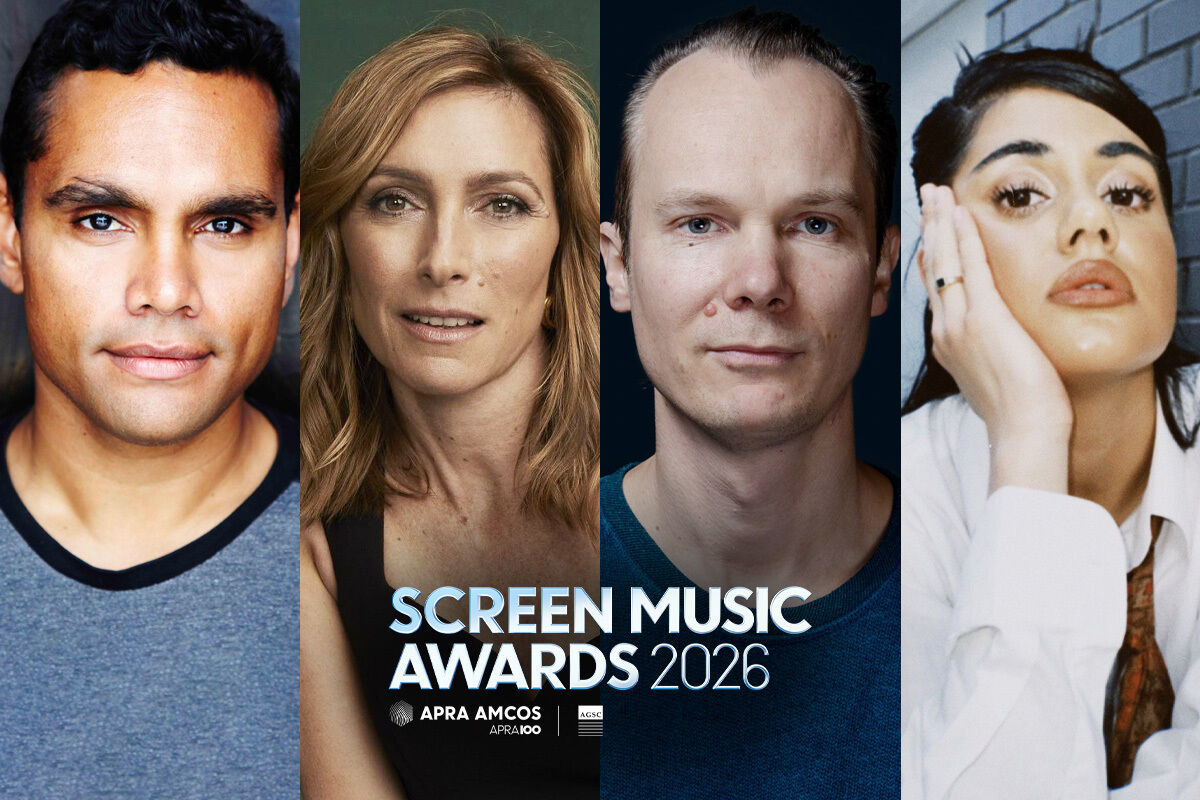
Nominees
| Emerging Screen Composer of the Year |
|---|
NOMINEES |
| Finn Clarke |
| Andreas Dominguez |
| Emma Greenhill |
| Genevieve Patrick |
| Best Music for an Advertisement | |
|---|---|
Nominees | |
| Title: | Lego – Project Vehicles |
| Composed by: | Benjamin Lam |
| Published by: | Massive Publishing |
| Title: | Sarah & Sebastian - Ondine |
| Composed by: | Mara Schwerdtfeger |
| Title: | Telstra – Tame Your Tech |
| Composed by: | Scott Langley |
| Published by: | Smith and Western Studios |
| Title: | Voice of Resistance |
| Composed by: | Fred Leone* / Mariah Alone / Dion Brownfield^ / Caleb Tasker# / Skye Thomas / Corey Webster / Dallas Woods^ |
| Published by: | Sony Music Publishing* / Kobalt Music Publishing^ / BMG Publishing# |
| Best Music for Children's Programming | |
|---|---|
Nominees | |
| Title: | Caper Crew |
| Composed by: | Steve Toulmin |
| Title: | Kiki Can Fly (Zoo, Special Edition) |
| Composed by: | David Skinner |
| Published by: | Origin Music Publishing |
| Title: | Tales from Outer Suburbia (Episode 10) |
| Composed by: | Ned Beckley and Josh Hogan |
| Title: | The Pout-Pout Fish |
| Composer: | Ack Kinmonth |
| Best Music for a Documentary | |
|---|---|
Nominees | |
| Title: | Edge of Life |
| Composed by: | Antony Partos |
| Published by: | Sonar Music |
| Title: | Reported Missing (Season 5 Episode 1) |
| Composed by: | Adrian Leung |
| Published by: | BMG Publishing obo Manners McDade |
| Title: | Sentient |
| Composed by: | Helena Czajka |
| Title: | Whistle |
| Composed by: | Haydn Walker |
| Best Music for a Short Film | |
|---|---|
Nominees | |
| Title: | Filthy |
| Composed by: | Chiara Costanza |
| Published by: | Kobalt Music Publishing |
| Title: | Spiders on My Lashline |
| Composed by: | Freya |
| Title: | Trading Cards |
| Composed by: | Nicholas Gardiner |
| Title: | The Worm |
| Composed by: | Callum O’Reilly |
| Best Music for a Television Comedy | |
|---|---|
Nominees | |
| Title: | Dog Park (Episode 1) |
| Composed by: | Bryony Marks |
| Published by: | Kobalt Music Publishing obo LilliPilli IP |
| Title: | He Had It Coming (Episode 7) |
| Composed by: | Caitlin Yeo |
| Published by: | Kobalt Music Publishing obo LilliPilli IP |
| Title: | Sunny Nights (Episode 1) |
| Composed by: | Matteo Zingales |
| Published by: | Sonar Music |
| Title: | The Witchy Girls (Episode 6) |
| Composed by: | Peter Corrigan / Georgina Darvidis / Matthew Sheers |
| Best Music for a Television Drama | |
|---|---|
Nominees | |
| Title: | Playing Gracie Darling (Episode 5) |
| Composed by: | Jan Skubiszewski |
| Title: | Reckless (Episode 4) |
| Composed by: | Cassie To and Emma Greenhill |
| Published by: | Universal Music Publishing |
| Title: | The Artful Dodger (Season 2 Episode 3) |
| Composed by: | Antony Partos |
| Published by: | Sony Music Publishing |
| Title: | The Family Next Door (Episode 1) |
| Composed by: | Bryony Marks |
| Published by: | Kobalt Music Publishing obo LilliPilli IP |
| Best Music for Unscripted or Reality Television Series | |
|---|---|
Nominees | |
| Title: | Beyond Bali with Lara Lee |
| Composed by: | Amara Primero and Melany Thompson* |
| Published by: | Cooking Vinyl Publishing / Primerchord Music* |
| Title: | Million Dollar Secret (Season 2) |
| Composed by: | Adam Gock* / Dinesh Wicks* / David Bruggemann* / Rory Chenoweth* / Lydia Davies / Brontë Horder* / Adam Sofo* / Mitch Stewart* / Cassie To* |
| Published by: | BMG Publishing* |
| Title: | Muster Dogs (Season 4) |
| Composed by: | Mark Walmsley |
| Published by: | Universal Music Publishing |
| Title: | Tucci in Italy (Season 2) |
| Composed by: | Richard Pike |
| Publisher: | Sony Music Publishing |
| Best Music for a Video Game or Other Interactive Media | |
|---|---|
Nominees | |
| Title: | Bluey’s Quest for the Gold Pen |
| Composed by: | Cedar Jones |
| Title: | Hollow Knight: Silksong |
| Composed by: | Christopher Larkin |
| Title: | Malys |
| Composed by: | Belinda Coomes |
| Title: | Mixtape |
| Composed by: | Josh Abrahams and Jonathan Tron |
| Best Opening Title Television Theme | |
|---|---|
Nominees | |
| Title: | Flower and Flour |
| Composed by: | Hylton Mowday |
| Published by: | Kobalt Music Publishing obo Cheeky Little Media |
| Title: | Reported Missing |
| Composed by: | Adrian Leung |
| Published by: | BMG Publishing obo Manners McDade |
| Title: | Revealed: Death Cap Murders |
| Composed by: | Simon Walbrook |
| Title: | Tales from Outer Suburbia |
| Composed by: | Ned Beckley and Josh Hogan |
| Best Original Song Composed for the Screen | |
|---|---|
Nominees | |
| Title: | Nothing Stays the Same from Tales from Outer Suburbia |
| Composed by: | Ned Beckley / Joni Hogan / Josh Hogan |
| Title: | Nug Luck from Caper Crew |
| Composed by: | Steve Toulmin |
| Title: | The Spirit Shall Return from Mystery Road: Origin |
| Composed by: | William Barton |
| Published by: | Wise Music G Schirmer Australia |
| Title: | We Got Away With It from He Had It Coming |
| Composed by: | Caitlin Yeo |
| Published by: | Kobalt Music Publishing obo LilliPilli IP |
| Best Soundtrack Album | |
|---|---|
Nominees | |
| Title: | Christy |
| Composed by: | Antony Partos |
| Published by: | Cas Music |
| Title: | Deadloch (Season 2) |
| Composed by: | Amanda Brown |
| Published by: | Universal/MCA Music Publishing |
| Title: | Tales from Outer Suburbia |
| Composed by: | Ned Beckley and Josh Hogan |
| Title: | Together |
| Composed by: | Cornel Wilczek and Alex Olijnyk |
| Feature Film Score of the Year | |
|---|---|
Nominees | |
| Title: | Addition |
| Composed by: | Piers Burbrook de Vere and Rose Mackenzie-Peterson |
| Title: | Christy |
| Composed by: | Antony Partos |
| Published by: | Cas Music |
| Title: | Monument |
| Composed by: | Kenneth Lampl |
| Published by: | Alba Australia Music Publishing |
| Title: | War Machine |
| Composed by: | Dmitri Golovko |
| Published by: | BMG Publishing |
| Most Performed Screen Composer - Australia | |
|---|---|
Nominees | |
| Composers: | Adam Gock & Dinesh Wicks |
| For: | MasterChef, Travel Guides, My Kitchen Rules |
| Composer: | Damian de Boos-Smith |
| For: | Better Homes & Gardens, The Block, Return to Paradise |
| Composer: | JAY STEWART |
| For: | The Block, It’s Acadamic, Better Homes & Gardens |
| Composer: | MITCH STEWART |
| For: | MasterChef, Travel Guides, My Kitchen Rules |
| Most Performed Screen Composer - Overseas | |
|---|---|
Nominees | |
| Composers: | ADAM GOCK & DINESH WICKS |
| For: | Married at First Sight, Lego Masters, Con Girl |
| Composer: | ANTHONY AMMAR |
| For: | Married at First Sight, Love on the Spectrum, MasterChef |
| Composer: | JOFF BUSH |
| For: | Bluey, The Strange Chores |
| Composer: | MITCH STEWART |
| For: | Married at First Sight, Lego Masters, Con Girl |
About
The Screen Music Awards represent the successful marriage of two defining elements of contemporary Australian culture: music and film. Presented by APRA AMCOS in conjunction with the Australian Guild of Screen Composers (AGSC), the ceremony is our chance to acknowledge excellence and innovation in the field of screen composition.
The Screen Awards honour music composers across fourteen categories. APRA AMCOS uses statistical analysis to define nominations based on performance activity, as reflected by earnings, for two categories: Most Performed Screen Composer - Australia, and Most Performed Screen Composer - Overseas. Panels of highly respected Australian film and television composers determine four nominees across each of the remaining twelve categories. The Distinguished Services to the Australian Screen and Emerging Screen Composer of the Year Awards are given at the discretion of the APRA Board of Directors.
Categories
The Screen Music Awards cover fourteen award categories.
The following awards are given based on APRA AMCOS' statistical analysis:
- Most Performed Screen Composer – Australia
- Most Performed Screen Composer – Overseas
The following awards are judged by panels of leading screen composers from across Australia:
- Best Music for an Advertisement
- Best Music for Children's Programming
- Best Music for a Documentary
- Best Music for a Short Film
- Best Music for a Television Comedy
- Best Music for a Television Drama
- Best Music for Unscripted or Reality Television Series
- Best Music for a Video Game or Other Interactive Media
- Best Opening Title Television Theme
- Best Original Song Composed for the Screen
- Best Soundtrack Album
- Feature Film Score of the Year
Two special awards are given at the discretion of the APRA Board of Directors:
- Distinguished Services to the Australian Screen Award
- Emerging Screen Composer of the Year
Submission Guidelines
SUBMISSIONS FOR THE 2026 SCREEN MUSIC AWARDS ARE NOW CLOSED.
The work must have been for a production which received its first public screening, broadcast or release in the relevant 12-month period (1 July 2025- 30 June 2026), excluding Feature Film Score of the Year.
The eligibility period for Feature Film Score of the Year requires that the production must have received its first public screening, broadcast or commercial release in the relevant 15-month period (1 July 2025 - 30 September 2026). This includes first releases on YouTube, Facebook, Netflix or any other public platform.
Submissions will only be accepted via the official Screen Music Awards online portal.
Submissions can be entered by the composer, their employer, the production company or a third party i.e. Director or Publisher.
You must submit responses to:
- Details of the work's first broadcast (date, location and platform)
- Composer information
- Any additional composer/s
You must supply:
- High-res headshot and biography (maximum 300 words) of the main composer
- High-res head shot of any co-composers or additional composers
- Your work as an mp4 or MOV file (Soundtrack entries may submit in mp3/m4a format), or as a direct link accessible with or without a password. Please note only standard definition files are required.
- If you are providing your work via a link, please ensure that both the link + password (if applicable) are made available until Friday 28 August so that there are no disruptions to the judging process. Failure to do this may result in your submission not being able to be judged in all rounds.
- If you are providing your work via a link, please ensure that it is a link available without the judges having to sign up to a streaming service, eg. ABC iView, Netflix, Stan etc.
- If you are providing your work via a link, please ensure that it is a link available without the judges having to sign up to a streaming service, eg. ABC iView, Netflix, Stan etc.
- If you are providing your work via a link, please ensure that both the link + password (if applicable) are made available until Friday 28 August so that there are no disruptions to the judging process. Failure to do this may result in your submission not being able to be judged in all rounds.
- All submissions must have audio-visual elements included, with the exclusion of Soundtrack category (audio only accepted for this category).
- Cue Sheet with time codes are required for the Best Music for a Television Drama, Best Music for a Television Comedy, Best Music for Children’s Programming, Best Music for a Documentary & Feature Film categories.
- An audio-only sample of the main score (mp3 or m4a), minimum of 2.5 minutes in length. This is required for possible adaptation/orchestration by the Musical Director for the orchestral ensemble at the awards ceremony.
- Any additional material that could be used for possible adaptation/orchestration by the Musical Director - lead sheets, MIDI files, manuscripts.
Submissions into the Emerging Composer category must include:
- A showreel consisting of the composer’s scores/works (up to 15 minutes). We recommend including just your best 3-4 works. A shorter, high-quality reel is preferred, and judges only need to see your strongest material.
- A CV outlining the composers works including all composer credits
Submissions into the Best Music for a Video Game or Other Interactive Media category:
- Can be an mp4 or MOV file.
- The file/video must be a screen record of gameplay. The footage can be edited to contain the most important musical moments featured in the game, at the composer’s discretion.
- There is no minimum duration but there should be a maximum duration of 30 minutes.
- A description of how your score interacts with player inputs and player progression if at all, as related to your video submission (300 words maximum).
Submissions into the Best Music for Unscripted or Reality Television Series category must include:
- An up to 15-minute reel consisting of original works, which may be composed by an individual or multiple composers.
- Each show can only be submitted once so if multiple composers worked on a show, they must submit one entry with all composers listed as co-composers.
- The reel can feature cues from a variety of episodes but must be from the one season that has been broadcast during the eligibility period.
- This category is for bespoke music commissioned and composed for the series, not for production music that is part of a generic music library.
Indigenous Cultural and Intellectual Property (ICIP)
If a submitted work includes Indigenous Cultural and Intellectual Property (ICIP), appropriate consultation and permissions must be obtained. For the purposes of these awards, ICIP may appear within:
- Music components (e.g. melody, lyrics, language, recordings, performance, cultural expressions embedded in the composition), and/or
- Screen content associated with the work (e.g. dialogue, on-screen text, imagery, performances, artwork, or other audiovisual elements).
Important:
Composers are only responsible for permissions relating to the music they have created or controlled. Where Indigenous content appears in the broader screen production (e.g. dialogue, storyline, visuals) and sits outside the composer’s role, composers should:
- identify the presence of this content, and
- confirm (to the best of their knowledge) that appropriate cultural permissions have been obtained by the production.
Where a composer incorporates ICIP into their music composition or sound elements, and that content is from outside their own cultural heritage, documented evidence of consultation and permission from the appropriate Cultural Custodians is required.
For more information on ICIP please view the FAQs at the bottom of this page, and for further queries please contact the Alyelhentye Nawu team at APRA AMCOS at [email protected]
Category information:
- You may apply in as many categories as you like, but a maximum of 3 entries in any one category applies, noting that multiple entries for the same show are not permitted.
- For submissions in the Best Music for a Television Drama, Best Music for a Television Comedy and Best Music Children’s Programming category you must upload only one entire episode that you feel best reflects your work. You are not able to submit multiple entries for the same show. If you are not the main composer of the episode, please list any additional composers.
- For submissions in the Best Original Song Composed for the Screen category, you may upload only the section of the film/program where the song is featured, or, the entire film/program with a timecode note where the song is featured.
Questions? Please email [email protected]
Rules
A. THE AWARDS
1. Fourteen Awards are conferred:
- Best Music for an Advertisement
- Best Music for Children's Programming
- Best Music for a Documentary
- Best Music for a Short Film
- Best Music for a Television Comedy
- Best Music for a Television Drama
- Best Music for Unscripted or Reality Television Series
- Best Music for a Video Game or Other Interactive Media
- Best Opening Title Television Theme
- Best Original Song Composed for the Screen
- Best Soundtrack Album
- Feature Film Score of the Year
- Most Performed Screen Composer – Australia
- Most Performed Screen Composer - Overseas
Two special Awards are given at the discretion of the APRA Board of Directors:
- Distinguished Services to the Australian Screen Award
- Emerging Screen Composer of the Year
2. The Award is in the form of a trophy suitably inscribed.
B. ELIGIBILITY
- The work must be an original score.
- The work must have at least a 50% composer interest by an Australian APRA Composer Member.
- The work must have been for a production which has received its first public screening, broadcast or release in the relevant 12-month period (1 July 2025 - 30 June 2026) for which the award is made (excluding Feature Film Score of the Year).
- The eligibility period for Feature Film Score of the Year requires that the production must have received its first public screening, broadcast or commercial release in the relevant 15-month period (1 July 2025 - 30 September 2026) for which the award is made.
- Submissions in the Feature Film Score of the Year category must be for a film that has a minimum duration of 70 minutes. Works under 70 minutes will not be eligible.
- In the case of any Television Dramas, Television Comedies or Documentaries with more than one episode, composers are to choose one episode only for submission into any one category.
- An Opening Title Television Theme is a piece of music that is played at the beginning of each episode in a Television Series.
- Revised Opening Title Themes from subsequent seasons may be submitted, provided the composer can demonstrate meaningful new compositional elements. Submissions that contain only minor alterations, production enhancements, or arrangement changes may be deemed ineligible.
- An entire work can only be entered into one category, such as Short Film OR Documentary, Television Comedy OR Television Drama, not both. However, portions of the same work can be entered into additional categories, e.g. Feature Film Score of the Year & Best Original Song Composed for the Screen, or Television Drama & Opening Title Theme.
- Anything classed as a children's program, whether it is a short film or tv series must be entered into the Children's Programming category. Children's full-length features are eligible to be entered into the Feature Film category at the composer's direction. Note that a children’s program cannot be entered into both the Children’s Programming and Feature Film categories – the composer must choose one category to enter.
- Anything classed as a Documentary, whether it is a television series, short film or feature length must be entered into the Documentary category. Feature length documentaries will not be accepted into the Feature Film Score of the Year category. Submissions into the Documentary category should be factual, in-depth content produced with an emphasis on evidence-based storytelling and analysis. Examples: John Farnham: Finding the Voice (2023), River (2021), Sherpa (2015), The Australian Wars (2022), My Name is Gulpilil (2021).
- Submissions into the Unscripted or Reality Television Series should reflect unscripted programming such as game shows, reality, variety, lifestyle or docu-reality, with a stronger focus on entertainment than factual depth. Examples: Australian Survivor, Love on the Spectrum, Bondi Rescue, Who Do You Think You Are?, Alone Australia.
- All Short Films submitted should have a running time of 40 minutes or less, including all credits.
- All Advertisements submitted should be limited to 3 minutes duration.
- Best Original Song Composed for the Screen must be an original composition written for that purpose, not a previously released song featured in a program or film. The category for Original Song does not include advertisements, jingles, promos or station IDs. Music videos are not accepted as entries to the Screen Music Awards.
- For submissions in the Best Original Song Composed for the Screen category, a “song” is defined as a musical work that includes both music and lyrics, performed vocally and created specifically for the screen production. Submissions that do need meet this definition may be deemed ineligible without review.
- All types of games and interactive media will be accepted into the Best Music for a Video Game or Other Interactive Media category, including games released for console, mobile, and desktop. The game must involve a screen, and so therefore submissions for non-digital board games, table top role-playing games etc. are not eligible. No gambling games are eligible to be submitted.
- For the Emerging Composer of the Year category, the composer must be an APRA Composer Member and the works submitted for consideration must be an original score.
- If an entrant is under the age of 18 (or the age of majority in their state, district, or territory of residence at the time of entry), such Entrant’s parent or guardian will be required to complete and submit the Online Application on the Entrant’s behalf and sign and submit a copy of the Parental Consent Form. The consent form is available within the Screen Music Awards online portal during the submission process.
- The composer must be within the 10 years of their first publicly screened screen composition (not including school/tertiary film festivals), or, listing on IMDB.
- Potential recipients should have no more than four (4) main credits (main credits being defined as Feature Film, Feature Documentary, TV Series or Mini-series where they are listed as full Composer).
- A candidate may put forward an argument to be eligible if they have more than four (4) main credits, if their main credits have not been released theatrically or achieved commercial distribution or been selected for major film festivals.
- An emerging composer may be nominated for this award for a maximum of two consecutive years if the Committee determines that the nominee still meets the criteria for the emerging composer category in the year immediately following their first nomination.
- The composer must be within the 10 years of their first publicly screened screen composition (not including school/tertiary film festivals), or, listing on IMDB.
- If an entrant is under the age of 18 (or the age of majority in their state, district, or territory of residence at the time of entry), such Entrant’s parent or guardian will be required to complete and submit the Online Application on the Entrant’s behalf and sign and submit a copy of the Parental Consent Form. The consent form is available within the Screen Music Awards online portal during the submission process.
- There is a maximum of three entries permitted in any one category. However, any individual composer can only receive a maximum of one nomination in any one category. This will be subject to review if there is a duplicate composer in the Top 4 with different APRA member co-composers.
- Submissions must be original works composed by an APRA member, and, therefore, should not comprise music or lyrics substantively generated by AI.
C. ASSESSMENT & DECISION MAKING PROCEDURES
- Submissions will be assessed based on their compositional craft, creativity, dramaturgy, innovation, originality and excellence.
- Awards will be decided by judging panels from entries submitted.
- A judging panel may not include any member who is a subject of a submission. Should such a situation arise, either the nomination must be withdrawn, or the judge must be replaced.
- There will be five (5) to eight (8) judges per category. Judges will receive material to review individually before making final decisions via a conference call.
- Each judging conference call will be overseen by an external Chairperson.
- Decisions reached by the judging panels are final and no discussion regarding the result shall be entered into once the process is complete.
- Judging panels may reserve the right not to make an award in a category where there is not an outstanding achievement.
- Judging panels may reserve the right to alter the category for which a submission has been received if another category is deemed more appropriate. Composers will be notified if this is the case.
- Nominations within the categories of Most Performed Screen Composer – Australia and Most Performed Screen Composer – Overseas will be assessed based on performance activity as reflected by earnings, according to APRA’s records.
- The Distinguished Services to the Australian Screen Award encompasses outstanding contribution to the Film and Television industry, including, but not limited to producers/directors, philanthropists, educators, music supervisors and event producers that provide promotion, opportunities and education for Australian Composers.
- Emerging Screen Composer of the Year is assessed by a judging panel, as appointed by the APRA Board, for an emerging screen composer. The recipients’ work should reflect outstanding achievement and the judging panels’ assessment that the recipient has composed scores of outstanding quality. All recipients must be a member of APRA. The final determination of this Award lies with the APRA Board of Directors.
- An emerging composer is defined as someone in the early stages of their professional career who is fully committed to their practice and ready to push ideas and artmaking in new directions. They are generally in the initial phase of building significant recognition, with a demonstrated original body of work, and are in the process of establishing a foothold in the music industry. Emerging artists generally have limited or no representation in the form of managers, agents and publishers. Unless the applicant has achieved a lot of early national success, an emerging artist is likely to have been honing their craft for less than 10 years, regardless of age.
D. ADDITIONAL INFORMATION & COPYRIGHT
All entrants are required to provide the following items for possible adaptation by the Music Director on the night;
- An mp3 or m4a recording of the main theme/score
- Any material that can be used for orchestration - lead sheets, MIDI files, manuscripts etc.
Please note that our arrangers and orchestrators will adapt your music scores to suit our orchestral line up.
The entrant shall, (or shall cause the copyright owner of the entry if different from the entrant), permit APRA AMCOS and any person APRA AMCOS authorises to perform the entry in and as part of any APRA AMCOS award ceremony and to record it for those purposes and for the purposes of communication to the public or promotional use.
The entrant agrees to allow APRA AMCOS to use audio and video from the APRA & AGSC Screen Music Awards for promotional purposes.
Questions? Please email [email protected]
Venue Accessibility
The Screen Music Awards and The Fortitude Music Hall are dedicated to providing an inclusive and accessible experience for all guests.
EARLY ENTRY
To ensure a smooth entrance, the Fortitude Music Hall offers early access for patrons with wheelchairs, caregivers, and those who require seating.
COMPANION CARDS
If you have a companion card, simply present it at the box office when your tickets are being scanned upon arrival. To arrange a companion card ticket before the event date, please contact [email protected].
HEARING ASSISTANCE
For individuals with impaired hearing, we have installed a radio frequency assistive listening system called ListenRF. This system transmits the same live audio content as our PA system directly to the listener without amplifying any ambient noise. To reserve a receiver and headphones for a show or event, please contact [email protected].
WHEELCHAIR ACCESS
The Fortitude Music Hall offers wheelchair access from street level. There are no steps at the entrance, allowing patrons with wheelchairs full access to the ground floor, including the main auditorium and wheelchair amenities.
To obtain more information about the setup on the evening of a particular showcase and to arrange priority wheelchair entry, please contact [email protected].
WHEELCHAIR PARKING
Please note that the Fortitude Music Hall does not have its own on-site parking. For wheelchair parking, we recommend reserving a spot at McWhirters car park, which is only a block away from the venue. This car park has a lift to all levels and no steps on entry or exit. Alternatively, you may choose to park on the street in the surrounding area using Brisbane City Council’s metered parking areas.
SUPPORT ANMALS AND GUIDE DOGS
The Fortitude Music Hall welcomes support and assistance animals. Please contact [email protected] prior to the show so that we can arrange priority entry and a reserved space if needed.
TOILETS
There are two sets of male/female bathrooms located at the Fortitude Music Hall. One set is on the ground floor in the foyer, and the other is located in The Outpost Bar on the mezzanine level. All bathrooms are on even ground with no steps required for entry. Additionally, there are two accessible, gender-neutral toilets available in the foyer and on the mezzanine. Please use the bathroom that is most suitable for you when visiting the Fortitude Music Hall.
SENSORY FRIENDLY SPACE
If you experience sensory issues and need a quiet space, please reach out to a friendly member of the APRA AMCOS or Fortitude Music Hall team, and we will assist you in finding a suitable area to decompress. Generally, The Outpost Bar on the mezzanine level provides a reprieve from the crowds in the auditorium. The music is lowered once the performance commences, and there is a TV set up that broadcasts the stage.
SOCIAL STORY
Please click here to view the event's social story. The social story is available in both pdf and word document formats.
CONTACT US
Should you have any questions or considerations not mentioned in the above, please contact us at [email protected] or call us on 1800 642 634.
FAQs - Indigenous Cultural and Intellectual Property (ICIP)
What is Indigenous Cultural Content?
Indigenous Cultural Content encompasses information conveyed through tangible and intangible cultural expressions, serving to communicate cultural preservation, artistic expression, political self-determination, and cultural sovereignty. This content, specific to people, place, and culture, extends beyond text, encompassing Indigenous stories, dances, songs, ceremonies, language, history, and other aspects of heritage and property.
APRA AMCOS advocates for the rights of Aboriginal and Torres Strait Islander people to make self-determined decisions regarding Indigenous Music, including defining what Indigenous Music is, determining its usage, specifying when and by whom it is used, and clarifying the purpose of its use.
What is Indigenous Cultural and Intellectual Property (ICIP)?
Indigenous Cultural and Intellectual Property (ICIP) pertains to the rights Indigenous people possess and uphold to safeguard their cultural heritage. ICIP encompasses a dynamic heritage, encompassing objects, sites, stories, images, knowledge, and other content transmitted across generations within a specific Indigenous group or its territory. It is also commonly referred to as "Cultural Heritage."
APRA AMCOS advocates for the global rights of Aboriginal and Torres Strait Islander individuals and communities to autonomously make decisions about their Indigenous Cultural Content and Intellectual Property (ICIP), including (but not limited to):
- Defining the elements contained within Cultural Works
- Determining permissible uses of Cultural Works
- Establishing when Cultural Works are to be utilised
- Setting permissions for those using or exposed to Cultural Works
- Clarifying the purpose behind the usage of Cultural Works
What types of ICIP are relevant in the Screen Music Awards?
ICIP may be present in:
- Music (composition, lyrics, recordings, performance)
- Dialogue or spoken language
- Visual elements (artwork, cultural imagery, people, locations)
- Broader screen content (story, themes, cultural references)
Am I responsible for ICIP used in the whole screen production?
No. Composers are responsible only for ICIP contained within the music or sound elements that have been submitted as part of the awards application. However, in some cases, if ICIP appears elsewhere in the screen work, composers should acknowledge it.
When do I need to provide permission documentation?
You must provide documentation if:
- Your music composition uses Indigenous ICIP, and
- The ICIP is from outside your own cultural heritage.
This includes use of language, cultural expressions, recordings, or musical elements.
What if the Indigenous content is only in dialogue or visuals?
If you did not create or control that content, you are not required to provide documentation.
You should still identify its presence and confirm (if known) that permissions have been obtained by the production
What counts as “consultation and permission”?
This involves engaging with the appropriate Cultural Custodians and receiving informed consent for the use of cultural material. Documentation may include:
- Written permissions
- Agreements
- Letters of support
Why is this required?
These requirements support:
- Respectful and ethical use of Indigenous cultural material
- Recognition of Cultural Custodians’ rights
- Alignment with ICIP best practice standards in Australia
What if I am an Indigenous creator?
You may still be asked to describe your connection to the material used. This ensures cultural authority is clear and respected.